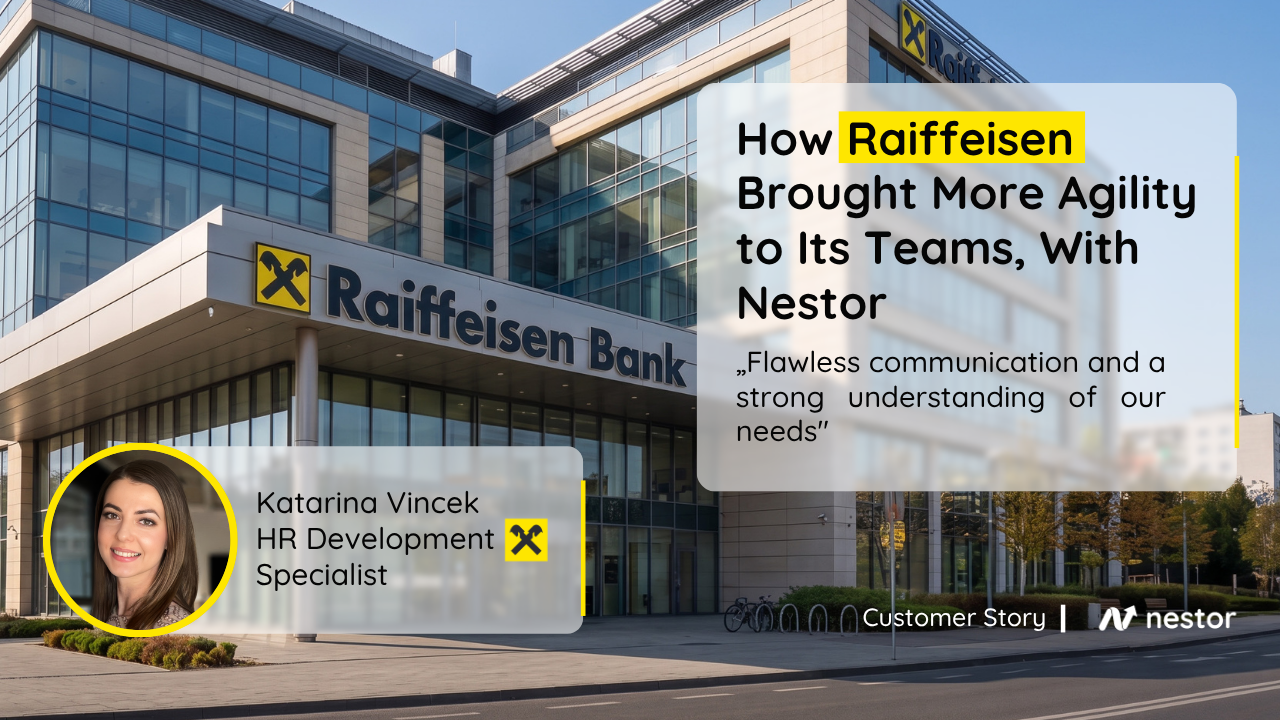
How Raiffeisen Brought More Agility to Its Teams, With Nestor
Inside a bank, few things move without a reason and a record.
Anything that touches employee data carries requirements that would stall most software before it ever reaches a single user. This is the environment agile teams at Raiffeisen Bank work in every day: fast-moving squads operating inside an organization built for caution.
Those teams are measured differently than the rest of the bank. What matters isn’t only what they ship, but how they work together to ship it: how they collaborate, take ownership, respond when priorities shift.
These are skills, even if they rarely get treated as such. And judging them through a manager’s view alone misses most of the picture. They show up between people, in the day-to-day of a team, which is exactly where peers can see them and a supervisor often can’t.
So Raiffeisen Bank ran a 360-degree survey built around agile behaviors. Feedback drawn from the people doing the work together. The survey itself was not new to the bank; structured feedback was already part of how these teams developed.
What Katarina, who coordinated the initiative, set out to answer was narrower and harder. How do you take a process people already rely on and make it better without unsettling the trust they’ve placed in it, and without tripping over the constraints that come with running anything new inside a bank?
Why Nestor fit what agile behaviors actually required
A survey is only as good as the thing it sets out to measure. Ask the wrong questions and you get tidy data about nothing that matters.
For agile teams, the thing that matters is hard to pin down on a standard performance form. Delivery is visible, the release shipped or it didn’t.
The work that produces good delivery lives underneath it: whether someone unblocks a teammate without being asked, whether they raise a problem early or sit on it, whether they adapt when the sprint changes shape halfway through.
These are capabilities, and they develop or stall like any other skill. Most evaluation systems never look at them directly, because they were built to track output, not behavior.
For Raiffeisen Bank, the survey itself was familiar ground. What changed was where it ran:
Since we are not conducting this survey for the first time, it is not new to our teams. However, what is new and represents progress is that we are conducting the survey on a more modern and user-friendly platform, which improves the user experience.
—
Katarina Vincek, HR Development Specialist at Raiffeisen Bank
That distinction is easy to underrate. The questions weren’t the innovation here. The teams had answered versions of them before. The progress was in the experience of taking part, and in what Nestor could do with the answers once it had them.
That’s where the choice of platform stopped being a technical detail. A generic survey tool collects answers, but it treats feedback as an event: a form goes out, results come back, the file gets archived.
Nestor was built around skills from the start, so it works the other way around. Feedback isn’t a standalone exercise. It’s how an organization reads the capabilities it wants to grow and ties them to development and to the goals the business is chasing.
For agile behaviors, that fit is structural, not convenient. The teams weren’t only being surveyed; they were being read through the same lens the bank uses to think about capability everywhere else.
That reframing is what gave the 360 its value. On Nestor, feedback on how someone collaborates or takes ownership wasn’t a score to be filed. It became a starting point, something a person and their manager could return to and build on.
Preparation was the part that made it work
In a big organization, a survey can lose momentum easily. People are busy, the invitation sits unopened, and participation slips before the thing has really started. Katarina’s team planned around that from the beginning.
The groundwork came first. Before anyone received a survey, the initiative was set up carefully and every step was explained ahead of time. As Katarina puts it:
A good foundation and preparation for the survey were established, and all steps were communicated clearly.
—
Katarina Vincek, HR Development Specialist at Raiffeisen Bank
That matters more in a bank than it might elsewhere. People here are cautious about anything tied to how they’re evaluated, so knowing the purpose and the process in advance is usually what decides whether they take part. Employees understood what was being asked of them and why. Managers understood what the results were going to be used for.
Because that context was in place before the survey went live, teams came to it already knowing what it was for and how it would work.
How Nestor closes the gap between feedback and growth
A completed survey can still be useless. The results come back, and a manager stares at a set of scores with no clear sense of what they’re supposed to see in them, while the employee wonders whether a low mark is a verdict or a suggestion.
Raiffeisen Bank dealt with this before it could happen, by giving both sides guidance written for their side of the exchange. Managers and employees each got guides covering how to use Nestor and how to read the results once they arrived. Katarina saw this as one of the things that made the difference:
It was very useful that both managers and employees received guides with detailed explanations of all steps, how to use the platform, and how to interpret the survey results.
—
Katarina Vincek, HR Development Specialist at Raiffeisen Bank
Handing someone a report is nothing; helping them understand what it’s telling them about their own habits at work is where most feedback processes quietly break down.
Nestor is built to be read, not just filled in (rated the easiest to use in its category by the people who work in it daily) and that mattered here, because a manager could sit with an employee and talk through what the feedback pointed to instead of decoding a spreadsheet.
That ease connected to something deeper in how Nestor is built. The 360 sits inside a system organized around skills, so a result didn’t just describe a person. It suggested where they might go next, which behaviors were worth working on. The conversations after the survey had somewhere concrete to go.
The part most vendors can’t clear: a bank’s constraints
This is where a lot of software stops. A bank brings security review, regulatory obligation, and legal sign-off to anything new, and most vendors either can’t meet those demands or slow to a crawl trying. For Raiffeisen Bank, this was the real test of whether the initiative could happen at all.
It’s also the part of the story Katarina spoke about at greatest length, and with the most conviction. She credits the implementation to how Nestor worked with them:
Nestor's highly professional approach, with flawless communication, a strong understanding of our needs, and flexibility in adapting to the specifics of our business environment, significantly contributed to the successful implementation of the entire process.
—
Katarina Vincek, HR Development Specialist at Raiffeisen Bank
What she’s describing is the difference between a vendor and a partner. A vendor delivers the product and leaves the constraints to the customer. Nestor worked inside them, adapting to how the bank operates rather than asking the bank to adapt to the software. In an environment this exacting, that distinction is what determines whether a project moves at all.
It mattered most where the requirements were hardest:
Given that, as a bank, we operate in a highly regulated environment with numerous security, regulatory, and legal requirements, we especially appreciate their willingness to collaborate, patience, and proactivity in finding appropriate solutions. This partnership-oriented approach enabled the initiative to be implemented in a structured and efficient way, fully aligned with all internal standards and constraints.
—
Katarina Vincek, HR Development Specialist at Raiffeisen Bank
That posture isn’t unique to this project. It shows up across Nestor’s work with other organizations, where the recurring note from customers is responsiveness and a readiness to configure the platform around real needs.
Raiffeisen Bank experienced the version a regulated environment demands: slower, more exacting, with less room for error. The implementation cleared every internal standard it had to, without the friction that usually comes with that kind of scrutiny.
What Raiffeisen Bank would tell other HR leaders
Asked what she’d say to other HR leaders weighing a structured 360 tied to skills and behaviors, Katarina didn’t point to the platform. She pointed to the practice:
In any more advanced HR environment, a 360-degree survey is a must-have tool that provides a foundation for and facilitates various subsequent HR processes.
—
Katarina Vincek, HR Development Specialist at Raiffeisen Bank
Her emphasis lands on foundation. A 360 isn’t meant to be a self-contained exercise that ends when the results come in.
It feeds what comes after: development planning, performance conversations, decisions about who’s ready for more. And that is exactly what Nestor is built to carry. Because the survey runs inside a system organized around skills, the results don’t stop at a rating; they connect to the capabilities a person can develop and the goals the business is working toward.
That’s what makes the platform choice matter beyond this one campaign. Raiffeisen Bank didn’t just run a survey on Nestor. It put the feedback somewhere it can keep working.
The same skills the 360 surfaced can feed development conversations, reviews, and the wider performance picture, without the results being exported, reformatted, and forgotten. For the teams, a single feedback campaign becomes the opening move in something ongoing.
For HR leaders working where nothing installs without scrutiny, that’s the part worth taking from the Raiffeisen Bank story. A proven practice found a better home in Nestor, a platform built around skills, run by a partner willing to work inside a bank’s constraints rather than around them.
Ready to grow your teams without compromising on compliance?
Financial institutions carry a particular weight when it comes to developing their people. Regulation shapes what can be measured and how, security requirements slow down anything new, and the pace of change in the sector keeps raising the bar on the skills teams need to stay competitive.
In that setting, feedback and development can’t be an afterthought. They’re how a bank keeps its workforce capable, aligned, and ready for what’s next.
Nestor is built for exactly that. By connecting 360 feedback, skills evaluation, and performance management in one place, it gives HR leaders in finance a clear view of the capabilities across their teams and a structured way to grow them. All while working inside the security, regulatory, and compliance standards the sector demands.
Want to see what Nestor can do for your team? Book a free demo to learn how Nestor can help you build a more engaged, aligned, and high-performing workforce.
Manage Consent
To give you the best experience on our site, we use cookies to store and/or access device information. By consenting, you allow us to process data such as browsing behavior on this site.
Functional
Always active
The technical storage or access is strictly necessary for the legitimate purpose of enabling the use of a specific service explicitly requested by the subscriber or user, or for the sole purpose of carrying out the transmission of a communication over an electronic communications network.
Preferences
The technical storage or access is necessary for the legitimate purpose of storing preferences that are not requested by the subscriber or user.
Statistics
The technical storage or access that is used exclusively for statistical purposes.The technical storage or access that is used exclusively for anonymous statistical purposes. Without a subpoena, voluntary compliance on the part of your Internet Service Provider, or additional records from a third party, information stored or retrieved for this purpose alone cannot usually be used to identify you.
Marketing
The technical storage or access is required to create user profiles to send advertising, or to track the user on a website or across several websites for similar marketing purposes.