


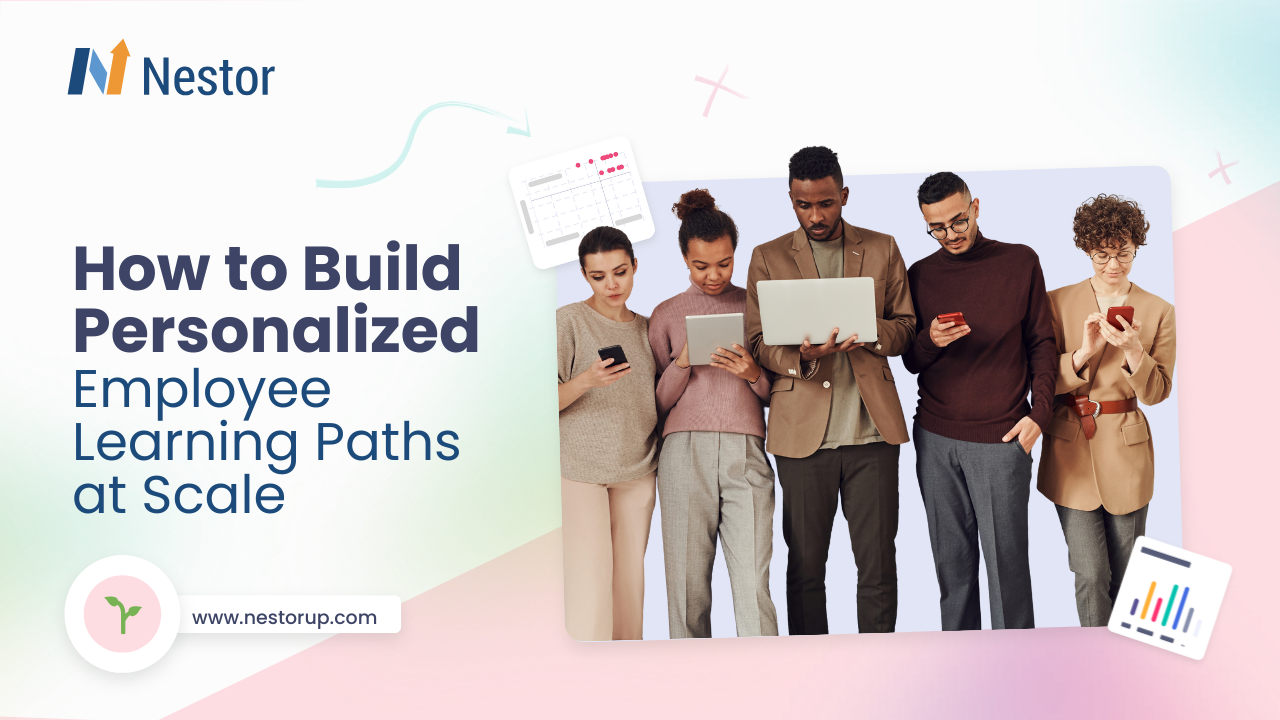
How to Build Personalized Employee Learning Paths at Scale
19 min read
Most people don’t remember much from corporate training. Some forget it the minute the tab closes. And honestly, who can blame them? Generic modules. Irrelevant topics. No personalized learning paths. Zero connection to their actual job or career goals. It’s no wonder employees click through just enough to avoid the reminder emails.
Now flip that. Picture a learning experience that feels like it was made for them. Something that says: we see where you are, we know where you want to go, and here’s how we’ll help you get there. That’s what a real learning path does. Not just a training plan but a sense of direction.
And we are not just saying that. According to LinkedIn, personalized learning paths can boost course completion rates by about 55% and improve performance outcomes by 21%. That’s the real-life impact a personalized plan can have.
The tricky part? Making that level of personalization work when you’re not just training five people. You’ve got teams spread across functions, seniority levels, time zones, and they all need something different. You want to help them grow, but you can’t spend your whole week handcrafting development plans.
So how do you scale something that’s supposed to feel one-on-one?
That’s what we’re unpacking here. How to build learning paths that actually matter to employees and how to do it without turning your L&D strategy into a second job. We’ll talk about the building blocks, the tech (including where platforms like Nestor can take the heavy lifting off your plate), and how to make learning stick in a way that’s both smart and surprisingly human.
First things first, what even is a learning path, and why should anyone care?
What Are Employee Learning Paths?
The phrase gets thrown around a lot, “learning path.” It sounds tidy. Almost too tidy for what it actually is.
At its simplest, a learning path is a sequence of learning experiences meant to help someone get better at something that matters to their job. That could mean becoming a stronger manager, brushing up on industry regulations, or slowly building up toward a role they’re aiming for next quarter or next year.
But a learning path isn’t just a random list of courses slapped together because they looked good in a catalog. It’s supposed to make sense for the person taking it. Not just their current job, but where they’re headed, what they care about, and what gaps they’re trying to close.
You can think of it like this: onboarding is a crash course. A learning path is more like a route you take when you actually know where you’re going but you want to get there smarter, not just faster.
Most paths include a mix of stuff:
- internal knowledge (SOPs, playbooks, documentation)
- external learning (certifications, LinkedIn Learning, Coursera, etc.)
- on-the-job practice (shadowing, stretch projects, coaching)
- feedback loops (reviews, check-ins, skills assessments)
The ingredients change depending on the company, the team, even the person. But the goal is always the same: help people learn what’s relevant without wasting their time.
And that’s where a lot of companies miss the mark. They confuse learning paths with content libraries. Having 500+ courses available isn’t the same as guiding someone through what’s actually useful for them. Without direction, people bounce around, get overwhelmed, or just disengage completely.
When learning paths are intentional and personalized, they give people a real sense of progress. Not just “I took a course,” but “I’m getting better at this thing that matters to me and my work.”
Why Personalization Matters in Corporate Learning
Here’s something most employees won’t say out loud but you can see it on their faces during training calls:
“This has nothing to do with me.”
There’s a pretty clear pattern in how people respond to workplace learning. If it feels useful, they lean in. If it feels generic, they tune out.
That’s exactly what individualized learning experiences are designed to fix. People are far more likely to engage with learning when it actually fits their role, their pace, and their goals. The impact is noticeable, measurable, and, frankly, overdue.
1. People Pay Attention Again
Most people aren’t against learning. They’re against wasting time. When content connects to what they’re trying to do at work (lead a team, close a tricky deal, manage their calendar without drowning), they’re in.
You don’t have to nudge them. They want it.
That’s why McKinsey found engagement went up by 30–50% in companies that built individualized learning experiences. The difference? Relevance.
2. Confidence Grows Quietly in the Background
Confidence doesn’t show up on a spreadsheet, but you’ll hear it in meetings. You’ll see it in how people write, present, delegate. Personalized paths give employees a chance to build skills in a way that actually matches how they learn, without making them feel behind or out of place.
That kind of steady progress builds belief in their own abilities. And that belief fuels just about everything else.
3. Learning Feels Less Like a Chore
When training is vague or too broad, it becomes one more thing to “get through.” But when it’s specific, when it solves real problems people are bumping into every week, it becomes useful. Even interesting.
It’s the difference between a random compliance module and a short session that actually helps you have hard conversations with your team. One gets muted. The other gets bookmarked.
4. It Keeps Good People from Walking Away
One of the biggest benefits of personalized learning for employees? It shows them there’s a future here. Not some vague promise of growth, but an actual roadmap.
People stay when they feel seen. Not managed, seen. A learning path that reflects their goals, strengths, and ambitions sends a signal that the company’s paying attention.
5. It Turns Training Into Actual Progress
Finishing a course is fine. But applying it, that’s the win. Personalized learning makes it way more likely that people will take what they’ve learned and use it the next day.
Because it’s not random. It’s tied to the real stuff:
- How they run a meeting
- How they handle feedback
- How they solve everyday problems at work
Step-by-Step: How to Build Personalized Learning Paths at Scale
“At scale” is where personalization usually breaks down.
Everyone’s excited about customized learning… until it comes time to actually build it for a team of 500. Or a department that spans three continents. Or a workforce that includes frontline staff, mid-level managers, and people who still don’t know what half the acronyms in your LMS stand for.
So how do you make learning paths that feel personal and manageable?
Not by throwing more courses into your library. Not by writing a 90-page skills framework that no one reads. It starts with slowing down just enough to think about what people actually need. Then, using systems (and some tech) to make the hard parts less painful.
Here’s what that can look like in real life.
1. Start From the Work, Not the Catalog
Before you assign a single course, go back to the job.
What are people actually doing? What’s tripping them up lately? What skills separate someone who’s struggling from someone who’s thriving?
Too many learning paths are built backward, pulled from whatever’s available in the LMS. But employees don’t care what’s in the catalog. They care whether training helps them do their job better, with less stress and more clarity.
If you’re not sure where to start, ask their manager what great performance looks like. Or sit in on a few team meetings. You’ll pick up on patterns quickly: the skill gaps, the confidence gaps, the places where a little support would go a long way.
And don’t overthink it. You’re not building a curriculum for a master’s degree. You’re building support for real people trying to keep up with real work.
2. Group People by Needs, Not Just Roles
It’s tempting to start with job titles and work your way down. But job titles are messy and don’t always reflect what someone actually does day-to-day.
One marketing specialist might be deep into campaign analytics. Another might be running events and client pitches. They need different support. And giving them the same training path is how you lose both of them.
Instead, try grouping learners based on where they are in their development:
- Just stepped into people management?
- Struggling with time management?
- Getting ready to lead a project for the first time?
That kind of segmentation makes it easier to build learning that feels relevant, without having to personalize every single thing for every single person. You’re still creating structure, just without the assumptions.
3. Let the Tech Do What Tech Does Well
If you’re still assigning content manually you’re making it way harder than it needs to be. This is where your tools should help. If they don’t, it might be time to rethink the setup.
A platform like Nestor gives you real visibility into what people need, not just what they’ve completed. It maps skills to roles, tracks development over time, and pulls learning content from existing systems. No extra clicks. No endless syncing.
It also helps managers stay in the loop. So instead of pestering L&D for updates, they can actually support their people, see where someone’s growing, where they’re stuck, and what’s next on their path.
And the best part? You don’t have to rebuild your whole tech stack. Nestor plugs into what you already use so you’re not starting from zero.
4. Mix Formal Content With Real-Life Learning Moments
Courses are great. But they’re not everything.
Some of the best learning happens during regular work, when someone takes on a new challenge, gets feedback from a peer, or tries something that makes them a little uncomfortable.
Your learning paths should reflect that. Not just with content, but with:
- On-the-job projects
- Shadowing opportunities
- Regular check-ins with managers
- Peer-led discussions or quick debriefs
For example, instead of just assigning a “difficult conversations” module, you could follow it up with a team role-play exercise or suggest a 15-minute peer feedback challenge. That’s how concepts get tested, stretched, and remembered.
You don’t need to over-engineer it. You just need to make space for the learning that’s already happening to count.
5. Keep It Flexible and Expect Messiness
No matter how well you plan it, someone will skip a course. A manager will forget to follow up. A team will get restructured halfway through.
That’s not failure. That’s normal.
Learning paths work best when they’re flexible. Not rigid templates. Not locked tracks that can’t adjust once someone’s role or goals shift. Build in checkpoints. Add room for people to self-direct, skip ahead, or request something different.
Also, ask for feedback while the path is still in motion. What’s landing? What’s not? What’s missing? People will tell you, and usually pretty quickly. You just have to be open to course-correcting along the way.
6. Make Growth Part of the Culture
This one’s bigger than content. If managers treat learning like “extra work,” their teams will too. If performance conversations don’t touch on development, people will stop thinking about it.
So make it part of the rhythm:
- Talk about learning during 1:1s
- Tie learning paths to actual goals, not just HR objectives
- Recognize progress publicly, not just quietly in a system
The more visible and normal growth becomes, the easier it is to get people to care about their own learning path. And once they care, you don’t need to “drive adoption.” It happens.
Best Tools for Creating Personalized Learning Paths at Scale
Let’s say your learning paths are solid. You’ve done the hard thinking: mapped roles, clarified skills, listened to what people actually need. You’re not guessing anymore.
But here’s where things either move forward or stall completely.
Because no matter how thoughtful your learning strategy is, if the tools underneath it aren’t designed to handle complexity without turning it into chaos, you’ll end up back where you started: stuck in manual workarounds, buried in spreadsheets, and wondering why no one’s finishing what they started.
So let’s talk tools, not from a features checklist perspective, but from a usability, visibility, and decision-making lens.
What Good Learning Infrastructure Should Actually Enable
In practice, here’s what your tools need to help you do, consistently, and without five different logins.
They should:
- Reflect how your company actually works
- Surface what’s missing, not just what’s been completed
- Connect skills, performance, and learning into one feedback loop
- Support managers, not just admins
- Stay adaptable as roles, priorities, and teams shift
This is about building an ecosystem that allows personalization to stay personal, even as the business changes around it.
Nestor: Making Learning Paths Actually Work in Practice
This is where Nestor shows up as more than just another learning platform. It focuses on one key problem: most learning systems don’t understand the difference between activity and growth.
Nestor does.
Here’s how:
- Skill Mapping That’s Actually Usable Nestor doesn’t just show you a list of skills. It ties those skills to roles, goals, and behavior. So instead of assigning a course because it looks relevant, you’re seeing what’s missing in someone’s current skill profile, and giving them something to close that gap.
- Dynamic Paths That Evolve People change. Roles shift. Projects come and go. Static learning plans age fast. Nestor updates paths as people move, develop, or reprioritize. It’s not reactive, it’s responsive.
- Manager Visibility Without Micromanagement Managers don’t need dashboards packed with color-coded pie charts. They need to know: who’s learning, where they’re progressing, and where they might need help. Nestor gives them just enough to coach well, without overwhelming them or turning them into admins.
- Content-Neutral and Stack-Friendly Whether you’ve got 5 years of internal courses, a Coursera license, or a mix of free and paid content, Nestor doesn’t care. It integrates with what you’re already using and keeps everything connected behind the scenes.
- Performance Integration If you can’t connect learning to how someone’s actually performing, it’s just theory. Nestor pulls data from performance reviews, 1:1 feedback, and development plans to make learning part of the bigger picture, not some separate side project.
It’s clean, quiet tech that does its job well. And when something works without making itself the center of attention? That’s rare.
If You’re Comparing Tools, Ask These Questions First
Not every company needs the same setup. But if you’re evaluating vendors or cleaning up your tech stack, these questions can cut through the noise:
- Can we see what skills are growing, not just what’s been assigned?
- How easily can we adjust learning paths when roles or goals change?
- Does this platform help managers actually support their teams’ growth?
- How well does it integrate with the systems we already use?
- Can we link learning back to performance conversations or outcomes?
If the answer to most of those is “not really” or “we’d have to build a workaround,” that’s not a tool. That’s technical debt.
Other Platforms Worth Exploring
Depending on your company’s stage and structure, here are a few others worth your radar:
- Coursera for Teams – Excellent for depth and credential-based learning. Better when paired with internal coaching or career development conversations.
- LinkedIn Learning – Solid for on-demand, professional development content. Best when integrated into a broader skills framework that ensures the right content reaches the right people.
- Degreed – Good for aggregating content across multiple providers. Can help expose learning opportunities, though it needs a strong skills foundation underneath.
- Learnerbly – Employee-led learning marketplace. Great for giving people choice and agency—works even better when paired with role-specific learning paths.
But none of them, not even the best ones, work in isolation. Your tool won’t build a culture. It won’t clarify roles. It won’t fix communication between L&D and frontline managers.
That’s still on us.
What it can do is remove friction. And when people aren’t constantly fighting the system, they tend to focus more on learning and less on logistics.
Measuring Success and ROI of Personalized Learning Paths
If you’re building personalized learning paths at scale, you already know the stakes: effort without evidence doesn’t fly. At some point, usually sooner than you’d like, someone’s going to ask what it’s all adding up to. Not in theory. In business terms.
And “engagement” isn’t enough.
You need to show that your learning strategy is helping people perform better, move faster, and grow into roles the business actually needs. That it’s closing gaps that matter. That it’s not just content delivery. It’s capability development.
That’s the real ROI.
And it doesn’t live in a completion rate or Net Promoter Score. It lives in work.
What You Should Actually Be Tracking
These are the signals that show whether your learning paths are doing their job or just looking busy.
1. Skill Progression Over Time
You’re not just trying to get people through content. You’re trying to grow competence. The question is: are people building the right skills, and can you prove it?
Track:
- Skills gained per path or initiative
- Skill depth across departments, roles, or teams
- Progression pace; how long it takes to move from basic to proficient in role-critical areas
If your platform shows completions but can’t reflect skill movement, you’re missing the point.
2. Goal-Relevant Application
You built the path for a reason: new leaders, faster ramp, fewer support tickets. So, did it work?
Connect learning to:
- Time-to-productivity
- Performance deltas after specific path completions
- Project delivery quality (or velocity) improvements
This is what measuring ROI of employee learning programs actually looks like: tracking what happens after the training, not just inside it.
3. Manager Visibility and Usage
Managers shouldn’t need three systems and a spare afternoon to answer: “Who’s developing on my team?”
You want:
- Role-level views of skill health
- Alerts when someone stalls, advances, or veers off path
- Insight into what’s working not just what’s being used
If your learning data doesn’t help managers make better decisions, it’s not serving the business.
4. Mobility and Readiness, Not Just Promotions
Promotions are a lagging indicator. Start measuring the leading ones:
- Time from learning path completion to role eligibility
- % of critical roles filled internally
- Readiness heatmaps for teams or functions
- Bench strength: not how many people are “interested,” but how many are ready
These are the kinds of metrics that justify personalized learning at scale. Not because they look good but because they reduce risk and hiring dependency.
5. Drop-Off Points and Relevance Gaps
Don’t just track success. Track friction.
- Where do people stop?
- Where do managers stop assigning?
- Which paths have high completion but no measurable impact?
Relevance is ROI. If a path made sense when you built it but feels disconnected now, that’s a signal not a failure.
What Tools Should Be Able to Show You
You shouldn’t need five spreadsheets, a BI analyst, and a guess to get this right. If you’re serious about ROI, your tools should give you:
- Skill movement data tied to real work, not just checkboxes
- Visibility into path engagement and path outcomes
- Insight into how learning maps to team performance and org priorities
- Built-in learning analytics not buried exports
- Feedback loops: employee and manager input that updates the system, not just surveys to file away
This is where platforms like Nestor stand out. It doesn’t just track activity. It connects personalized learning paths to actual growth and performance patterns.
You get:
- Dynamic skill profiles based on live role requirements and goals
- Integrated views of learning, performance, and progression
- Actionable insights managers can use without training or translation
- Early signals when someone’s off-track or underdeveloped
- Role-readiness data that feeds directly into career planning
It’s not about proving learning happened. It’s about showing why it mattered.
Real ROI Looks Like This
Skip the engagement stats. Lead with:
- “We reduced new hire ramp by 22% in Q2.”
- “Four frontline managers stepped into regional roles after targeted development.”
- “We closed three key skill gaps across product and engineering in under 60 days.”
- “We were able to reallocate talent internally instead of hiring for two roles externally.”
Those aren’t learning metrics, they’re business metrics. And they are the ROI.
Final Thoughts About Personalized Learning Paths
Here’s the bottom line: generic training doesn’t scale, it fades. People tune out, managers disengage, and the business moves on without real growth.
But when you treat learning like something that should feel specific, useful, and relevant right now, people respond. They learn faster. They contribute more. They stay longer. And your L&D team stops acting like a content vending machine and starts acting like a growth engine.
Building personalized learning paths at scale isn’t about doing more. It’s about doing what matters, for the right people, at the right time, in the flow of real work.
Whether you’re trying to close skill gaps, support internal mobility, or reduce hiring dependency, the tools exist and the business case is solid.
The next step? Stop guessing. Start designing. Start building learning paths today that reflect how your workforce actually works.
👉 If you’re ready to see how Nestor can help with that — smart, scalable, and built around real performance — book a demo.
Because personalized learning shouldn’t feel like a side project. It should feel like part of the job.
Frequently Asked Questions About Personalized Learning Paths
What’s the difference between a learning path and a training module?
A training module is a standalone piece of content, like a course or video. A learning path is a structured journey that maps multiple modules, experiences, and feedback loops to a specific skill, role, or career goal.
How do I personalize learning without creating a unique path for every individual?
You don’t need 500 unique paths. You need 5–10 modular templates that adapt based on role, skill gaps, and goals. Use role-based learning path templates and AI-driven tools to handle most of the segmentation.
What should a personalized learning path include?
A clear goal, a mix of content formats (videos, practice, coaching), role relevance, and checkpoints for feedback or reassessment. Bonus points if it includes performance data to validate progress.
Can I measure the ROI of personalized learning paths in hard numbers?
Yes. Track skill progression, time to productivity, internal movement, project impact, and manager sentiment. Tie learning outcomes to performance goals. Skip vanity metrics.
What platforms support personalized learning at scale?
Look for platforms that include skills intelligence, manager visibility, feedback loops, and LMS integration. Tools like Nestor are purpose-built for this, connecting learning directly to performance and development in real time.